Misla

Shrimp feeding tube, made to measure

Measure how far it is from the top of your glass down to the substrate and down to the water, the glass (or the frame) the clip goes over, and the biggest piece of food you use (at its widest, corner to corner on a wafer), and we will cut a feeding tube for that tank. It hangs on the edge of the glass and runs down to a small dish just above the substrate, so food that sinks down the tube is led into the dish rather than scattered over the gravel — food that sticks to the walls, or a knock to the dish, is another matter. The inside is square and sized from your food, and the tube prints lying on its side with no supports.
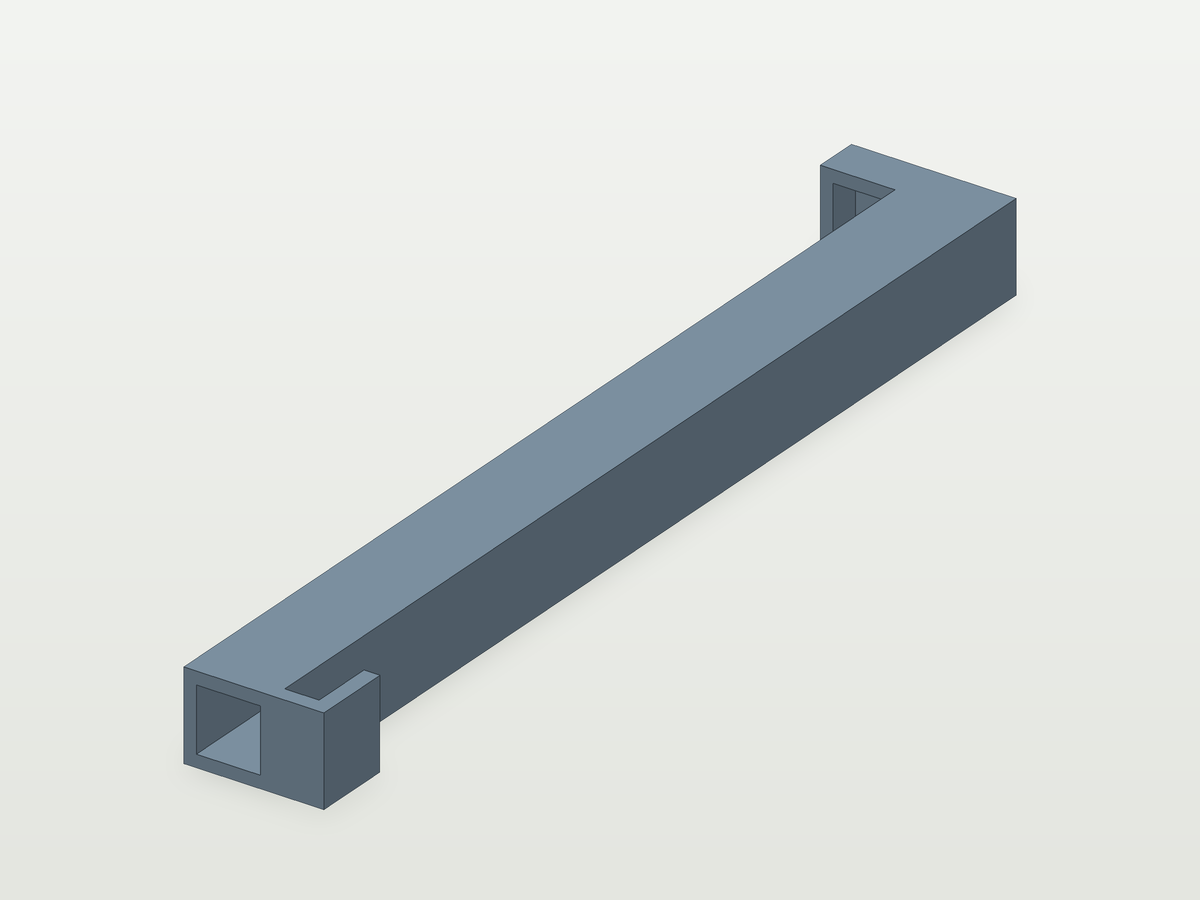
Shrimp feeding tube, made to measure
Rendered at our default measurements — yours comes out to your numbers.
What you need before you start

What it will take

  • From the top of the glass down to the substrate: 60–400 mm
  • From the top of the glass down to the water: 0–120 mm
  • Glass thickness: 3–19 mm
  • Frame width (0 if your tank has no frame): 0–40 mm
  • Frame depth on the inside (0 if no frame): 0–40 mm
  • Frame overhang inside the glass (40 = not measured): 0–40 mm
  • Biggest piece of food, measured at its widest: 1–25 mm
  • Nozzle size: 4 to choose from
  • Filament: 4 to choose from

As it comes

Length, from the top of the clip to the bottom of the dish198 mm
Inside of the tube, square12 mm
Dish above the substrate, worst case by our calculation3.6 mm
Filament, roughly38 g

Build plate: 198 mm as it comes, never more than 256 mm.

What you need to hand

  • A ruler for the drop from the top of the glass to the substrate and to the water, at the spot where the tube will hang.
  • A calliper for the glass — or, on a framed tank, for the width of the frame across its top and how far it comes down inside, and a ruler for how far its inside edge stands in from the glass (you can leave that one out, and we assume the worst case).
  • The biggest piece of food you use, measured across its widest point (corner to corner on a wafer).
  • Your nozzle size and the filament you will print it in.

The part, drawn to your numbers

198 mm40.2 mm50 mm · 1:5
From above, as it prints — lying on its side, with the clip at the left and the dish at the right

Drawn from the numbers in the form below, off the same geometry the file is cut from. It is not a photograph, and there is no photograph — every part that leaves here is a different size.

Your tank

Three things only your tank can tell you. Measure with the tank freshly topped up, at the spot where the tube will hang, from the top edge the clip will sit on.

mm
Measure straight down, on the inside of the glass, at the spot where the tube will hang: from the top edge the clip sits on to the surface of the gravel or sand. If your substrate slopes, measure at that spot. This sets the length of the tube.
mm
With the tank freshly topped up: the drop from the same top edge to the surface of the water. The mouth of the tube has to stand above it and the dish has to sit well under it.
mm
Measure the glass with a calliper, near the top edge. On a rimless tank this is what the clip goes over.
A frame round the top, if there is one

Rimless tanks: leave the width and depth at 0 and the overhang at 40. With a plastic frame, the clip goes over the whole frame, so we need its width and how far it comes down inside. How far its inside edge stands in from the glass is worth measuring too: left at 40, we assume the worst case.

mm
Only for a tank with a plastic frame round the top. Measure across the top of the frame, from its outside face to its inside edge, where the clip will sit: the clip goes over all of it. Leave it at 0 on a rimless tank.
mm
Only with a frame: how far its inside edge comes down below the top, on the inside of the tank. Leave it at 0 on a rimless tank.
mm
Only with a frame. Hold a ruler flat against the inside of the glass, just under the frame, and measure how far the frame's inside edge stands out from it — 0 if it is flush with the glass. Leave it at 40 if you have not measured it: we then take the worst case, with all of the frame on the inside of the glass, and a tube may be turned down for leaning too far that your frame would hold upright.
Your food

The biggest piece you will drop in, measured across its widest point: corner to corner on a wafer, not along its side. The inside of the tube and the way into the dish are sized from it.

mm
The biggest piece you will drop in, measured across its widest point — not along one side. For a pellet, its diameter; for a stick, its length; for a flat wafer, from corner to corner (a square wafer measures about 1.4 times its side that way, so a 10 mm wafer is about 14 mm). We size the inside of the tube and the opening into the dish from it.
The printer it will come off

Set these to the nozzle you will print with and the filament you will use; what is filled in is only our usual setting, not necessarily yours. The nozzle decides whether the walls come out the thickness we drew. The filament does not change the model: it sets the weight, whether the part stays down in the water, and flags PLA, which is for a dry fit only.

The nozzle you will print with. It does not change the model — it decides whether the walls come out the thickness we drew.
Sets the weight estimate, and flags PLA, which is for a dry fit only. It does not change the model.
Finer adjustments
mm
How far above the substrate the bottom of the dish hangs. The checks keep at least a millimetre clear once the tube leans on its clip and allowing for how long the print comes out.
mm
How much wider than the glass (or the frame) the slot of the clip is drawn. Looser goes on more easily, but the tube leans further and the dish drops a little.

More for your tank

  1. Airline holder for the glass

    A holder that slides over the edge of your glass and keeps one to three airlines upright down the inside, cut to your glass and your tubing.

    What you need A calliper for the glass and the outside of your airline tubing.

    Try your numbers

  2. Thermometer holder for the glass

    A holder that slides over the edge of your glass and keeps a glass or digital thermometer upright at the depth you choose, cut to your glass and your thermometer.

    What you need A calliper for the glass and across your thermometer.

    Try your numbers

  3. Fish net holder for the glass

    A holder that slides over the edge of your glass and keeps the handle of your fish net upright in a channel cut to its shape.

    What you need A calliper for the glass and both sides of your net’s handle.

    Try your numbers

Similar parts: Holders and hangers · Tank glass edge

See all 10 in Aquarium

Reviews

No reviews yet.

Reviews come from subscribers who have downloaded this part.