Soft jaws for your vice, cut to your jaws and your bars
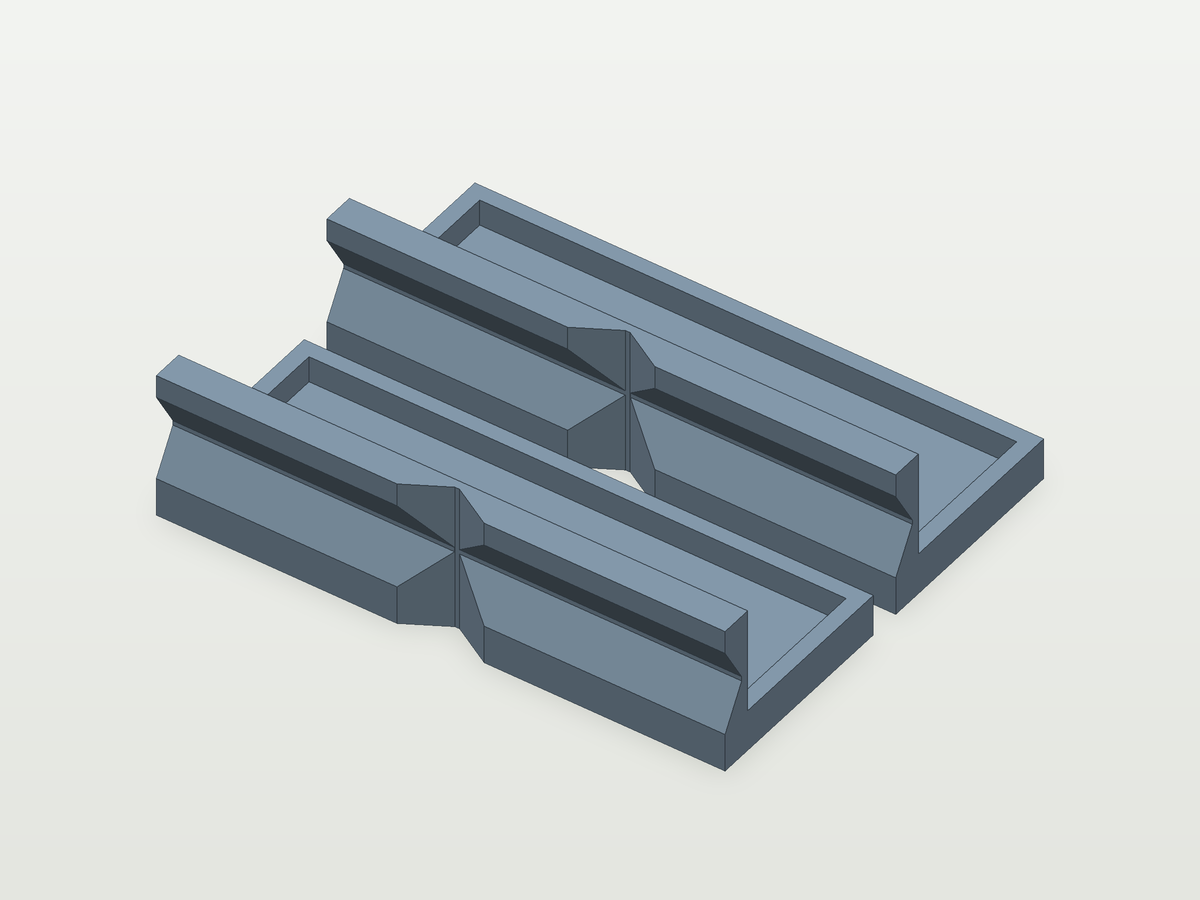
Measure one steel jaw of your bench vice — how wide it is, how tall its face is, how deep its top is — and the thinnest and thickest round bar you want to hold. We cut a pair of plastic caps that drop over your jaws and hook on, with a sideways and an upright V groove sized so that, by our sums, every bar in your range sits on the sloping sides of the groove in both caps — below the edge, clear of the floor, with the caps still apart. Prints upside down, no supports.
Rendered at our default measurements — yours comes out to your numbers.What you need before you start
What it will take
Jaw width: 40–200 mm
Height of the jaw face: 10–80 mm
Depth of the jaw top: 8–80 mm
Thinnest round bar: 3–60 mm
Thickest round bar: 3–60 mm
Groove angle: 6 to choose from
Lip down the back of the jaw: 0–10 mm
Magnet diameter: 0–20 mm
Magnet thickness: 0–6 mm
Nozzle size: 5 to choose from
Filament: 2 to choose from
As it comes
Sideways groove, depth at its point4.69 mm
Caps still apart on your thinnest bar, at worst1.48 mm
Vice opening the caps take up12.1 mm
Filament for the pair, roughly68 g
Build plate: 107 mm as it comes, never more than 256 mm.
What you need to hand
A caliper or a rule for one jaw of your vice: its width, the height of its face and the depth of its top.
The thinnest and thickest round bar you want to hold.
Optional: the size of any round magnets you have.
Your nozzle size and the filament you will print it in.
The part, drawn to your numbers
Side cut through both caps as they sit on the build plate, top of each cap down — with the sideways groove
Drawn from the numbers in the form below, off the same geometry the file is cut from. It is not a photograph, and there is no photograph — every part that leaves here is a different size.